

27 Playground Games No One Ever Explained the Rules To

Every neighborhood invented its own version of the same games, and nobody ever sat us down to explain the actual rules. We just watched the older kids and copied whatever they were doing, confidently, for years.
Carrie played one version through her entire childhood. Tom played what turned out to be a completely different game with the same name, three towns over.
We’re ranking twenty-seven games that ran entire recesses on rules that existed only in the memory of whoever showed up that day. Wait until you see number one. We still argue about how it actually worked.
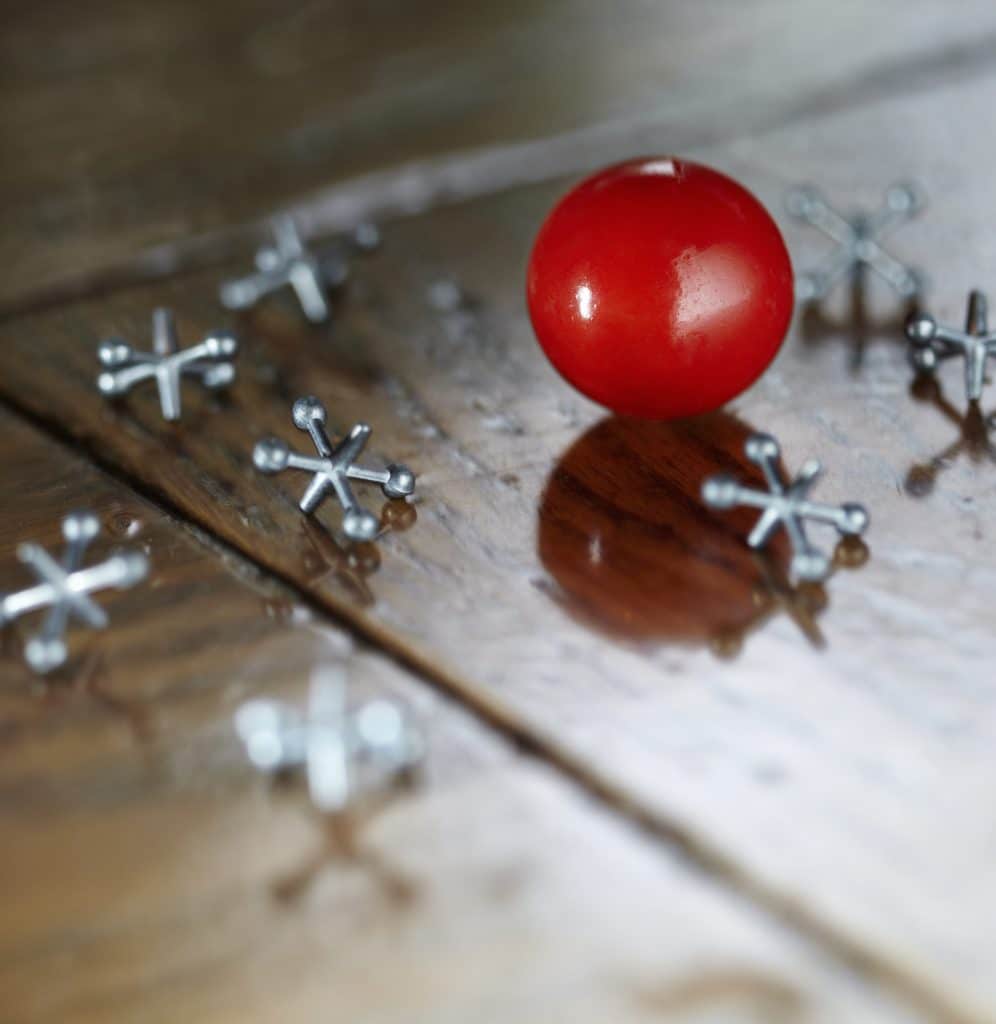
27. Jacks
Jacks looked simple from a distance: bounce a small ball, scoop up metal pieces, catch the ball before it lands twice. The actual scoring system was a mystery passed down like folklore. Somewhere around “twosies” everyone just started nodding along.
Nobody ever agreed on how many bounces you got, or whether dropping a jack mid-scoop ended your turn or just cost you a point. You learned the version your block played and defended it like scripture.
The verdict: a genuinely skillful game wearing the disguise of a coin toss.
26. Chinese Jump Rope
Getting “out” was its own unwritten code. Some groups only eliminated you for touching the rope with your hands, and others counted any wobble as a fail. You never knew which rules applied until you were already mid-jump.
Two kids stood inside a giant rubber band loop stretched around their ankles while a third jumped through a sequence of shapes nobody had named out loud. Ankles, knees, then somehow the whole thing got twisted into a diamond and everyone just accepted it.
The levels escalated from ankle height to waist height with zero explanation of how you were supposed to clear a rope stretched across someone’s hip. You watched the kid ahead of you and hoped your legs remembered.
25. Hopscotch
Numbering the squares seemed universal until you compared grids from different driveways. Some ran straight to ten, others looped back with a curved “home” square at the top that nobody could agree how to land in.
Everyone assumes hopscotch is self-explanatory because the grid is right there in chalk. What almost nobody agreed on was the marker rule. Some kids used a rock, some used a bottle cap, and the rules for what happened when it landed on a line changed depending on who drew the grid.
There was also a phantom rule about not touching the lines with your foot that got enforced with wildly different levels of seriousness. In some driveways it was law. In others it was ignored entirely.
24. Duck Duck Goose
The chase distance was never marked, so a fast goose could technically run a full lap around the yard before the tapper made it back to the empty seat. Nobody ever called that out as unfair, even when it clearly was.
A circle of kids sits down, one kid walks the perimeter tapping heads, and eventually a chase happens. That much everyone understood. What nobody explained was what happened if you sat back down in the wrong spot, or how long you were allowed to fake out the group before actually picking someone.
Half the drama of this game came from a kid circling the whole ring three times, building tension nobody asked for, before finally tapping a head. There was no rule against it. There was also no rule for it.
23. Simon Says
Whoever got out first sometimes became the next Simon, and other times the original Simon just kept going for the whole recess. There was no clear succession plan, so it mostly came down to who wanted the job.
The core idea is clean: only follow instructions prefaced with the magic phrase. In practice, every group of kids policed this differently. Some played that you were out for a single slip.
Others let it slide for the first offense and only enforced it when someone felt like being strict that day.
The real chaos came from borderline calls, like whether “Simon says stop” counted if you were already standing still. Entire recess periods were lost to that argument.
22. Mother May I
Forgetting to ask permission got you sent back, but the actual grammar requirement varied by yard. Some kids demanded the full phrase word for word. Others accepted anything that sounded roughly like a question.
You asked permission to take a certain number of steps, and if you forgot the magic words, you got sent back. Simple enough on paper. The actual step definitions were where things fell apart, because nobody had ever agreed on what a “giant step” measured against a “baby step.”
Some kids treated a giant step as a full lunge across the yard. Others took a normal step and called it giant with total confidence. The person in charge just had to decide who to believe.
21. Red Light Green Light
Run on green, freeze on red, get caught moving and go back to the start. The part nobody explained was how strict the freeze had to be. A wobbling foot could get you sent back in one game and completely ignored in the next, depending entirely on the mood of whoever was calling colors that day.
There was also no consistent rule about how fast the caller could spin around, which meant the whole thing occasionally turned into an accusation-fueled shouting match a few feet from the actual finish line.
Keep this one in mind. The version at number fourteen makes this look downright civilized.
20. Statues
A music version sometimes got mixed in, where the spinning stopped the second a song cut out instead of on command. Whichever version you grew up with felt like the only real one, and the other felt like a knockoff.
Someone spun you around by the arms and let go, and you had to freeze in whatever ridiculous pose you landed in. The winning criteria were never defined.
Sometimes the funniest pose won. Sometimes the stillest kid won, and the two categories rarely overlapped.
Judging fell to whichever adult happened to be nearby, which meant the outcome had less to do with skill than with who could make a tired parent laugh first.
19. Marco Polo
Nobody ever set a time limit either, so a determined seeker could spend an entire pool session with their eyes shut while everyone else quietly gave up and started a different game around them.
Eyes closed, one word called out, everyone else has to answer and dodge. The pool version had at least one rule everyone knew: no leaving the water. What nobody agreed on was whether you could stand flat-footed on the bottom to dodge, which some pools allowed and others treated as basically cheating.
The other unspoken rule was call frequency. Some kids called out constantly to sound busy. Others stayed dead silent and just hoped to be forgotten near the shallow end.
18. Tetherball
The serve itself was another gray area. Some courts required an underhand toss straight up before the first hit, and others let you just smack the ball the second you got possession.
A ball on a rope, wrapped around a pole, hit back and forth until someone wins by wrapping it all the way. The scoring made sense. The fouls did not.
Catching the ball, double-hitting it, or touching the rope all seemed to be violations, but the exact list changed depending on who was refereeing.
Most playgrounds ran on an honor system enforced by whoever yelled the loudest, which meant tetherball justice was less about the rulebook and more about who had the bigger group of friends watching.
17. Four Square
Four boxes, one ball, and a set of house rules so specific to each playground that transferring schools felt like moving to another country. Baby hits, cherry bombs, and Around the World were all real moves at some courts and instant outs at others.
The square you were in also mattered in ways nobody wrote down. Square one could call rules that applied to everyone, or could get overruled by group consensus, and figuring out which one applied on a given day was half the game.
16. Wall Ball
The line order added its own layer of confusion, since some courts rotated strictly by who was out first, while others just let whoever was standing closest jump back in.
Throw the ball at a wall, catch or let it bounce, and keep the rally alive until someone messes up. That much was consistent everywhere. The out conditions were where every playground diverged, especially around whether a ball hitting a crack or a corner counted as an automatic out.
Some courts played that catching your own throw before it hit the ground eliminated the next kid in line. Others had never heard of that rule and thought it sounded made up on the spot.
15. Box Ball
Even the size of the square mattered more than it should have, since a chalk grid drawn slightly bigger one week could change the entire bounce geometry the next.
A sidewalk square version of handball where the ball had to bounce once in your square before you hit it into someone else’s. The concept was clear. What counted as a fault changed by the sidewalk, sometimes literally, since a crack running through the wrong square could turn one court’s fair play into another court’s automatic loss.
There was also a persistent argument about whether hitting the ball with a closed fist versus an open palm mattered. Nobody ever produced a source for either position.
14. Double Dutch
Two ropes, turned in opposite directions, and a jumper trying to time an entrance that looked completely impossible from the outside. Nobody ever formally taught the timing. You just watched enough turns to feel the rhythm in your chest before you tried it.
Getting tangled early in front of everyone was a rite of passage rather than a real failure. The turners rarely slowed down for beginners, which somehow made success feel earned instead of handed to you.
The version of chaos at number four still beats this one for pure confusion, and that is saying something.
13. Steal the Bacon
Two lines of kids, numbers assigned, an object in the middle, and a call that sent one number from each side sprinting to grab it and get back without being tagged. The setup was easy. The tagging rules were where confusion lived permanently.
Nobody could ever agree whether you had to tag the runner before they touched the object or before they got back to their line. Different gym teachers taught different versions, and kids just carried whichever one they learned into every future game with total confidence.
12. Kick the Can
Guarding the can too closely felt like an obvious loophole, but almost nobody had a rule against it. The seeker just had to decide how much personal space felt fair on any given evening.
A hide-and-seek variant with an extra layer: anyone caught could be freed if a hidden kid snuck out and kicked the can before getting spotted. That single mechanic turned every round into a negotiation nobody had actually negotiated.
How close you had to get before kicking, whether you could kick it from a sprint, and how long the seeker had to guard it were all unwritten. The can itself usually ended up dented beyond recognition by the end of summer.
11. Red Rover
Two lines of kids holding hands, calling a name from the other side, and daring them to run and break through the chain. This one deserves an honest confession: the whole premise is a kid running full speed into locked arms, and it produced more skinned knees than any game on this list.
Nobody ever explained what happened if a runner just could not break through. Some groups made the failed runner join that team, others sent them back to their own line to try again, and the choice usually came down to whichever line had fewer people.
Plenty of schools eventually banned this one outright, and honestly, looking back at how it actually worked, that tracks.
10. Capture the Flag
Tag-backs were the other constant argument, meaning whether a freed prisoner could be tagged again immediately after crossing back into enemy territory. Roughly half the kids on any given team thought that was obviously against the rules.
Two territories, two flags, and a jail system that every group reinvented from scratch. The core goal made sense to everyone within thirty seconds. The jail rules took the rest of the afternoon to sort out, usually through shouting.
Could you free a whole line of prisoners with one tag or just one at a time? Was there a safe zone around the jail? Every yard answered these differently, and the answer usually favored whichever team currently had the most prisoners.
9. Hide and Seek
The closing phrase varied by household too, somewhere between a full sung-out call and a single shouted word, and whichever one you grew up with sounded completely normal until you heard someone else’s version.
The most universally known game on this list still had massive regional gaps. The counting number ranged from ten to a hundred depending entirely on how patient the seeker felt that day. Nobody ever timed it.
Base rules were the real wild card. Some versions let hidden players sneak to base and call themselves safe at any point. Others played that once you were spotted, you were spotted, no matter how close you were to home.
8. Sharks and Minnows
The final round always felt the most unfair, since the last couple of minnows had to cross the exact same distance as the very first round, except now facing nearly the whole group.
A pool or open-field chase game where one or two kids started as sharks and anyone they tagged joined their side for the next round. The escalation made the game genuinely tense by the final round, when three minnows faced down a wall of sharks.
What nobody clarified was the starting distance, the boundary lines, or whether standing still counted as being caught. Every backyard pool ran its own slightly different tournament.
7. King of the Hill
Get to the top of a mound of dirt, snow, or playground equipment and stay there while everyone else tries to pull you down. There was no scoring, no timer, and no formal way to win beyond bragging rights that lasted until the next kid shoved you off.
Grabbing clothes, pulling legs, and full-on tackling were all fair game on some playgrounds and grounds for an immediate timeout on others. The line between rough and too rough moved constantly.
Number three on this list runs on the exact same energy, minus any pretense of rules at all.
6. TV Tag
Some groups played that a tagger could just wait you out next to your crouch, technically legal and deeply annoying, while other groups considered that a violation of some unspoken decency rule nobody had actually written.
You could avoid being tagged by crouching down and shouting the name of a show, which supposedly made you safe. Nobody ever set a limit on how long you could crouch there, which meant the fastest kids just squatted indefinitely and yelled show titles until their legs gave out.
Repeat names were sometimes banned and sometimes fine, and enforcement depended entirely on whether anyone was keeping track, which nobody actually was.
5. Freeze Tag
A few playgrounds even introduced an unofficial “medic” who could unfreeze with a special touch, a rule that seemed to appear out of nowhere and vanish just as fast depending on who was playing that day.
Get tagged, freeze in place, and wait for a teammate to unfreeze you with a touch. The concept is airtight. The unfreezing method was not, since some groups required a full high five while others allowed a light tap that barely counted as contact.
There was also constant debate about whether the person who was “it” could guard a frozen kid to prevent a rescue. Half the neighborhood said yes, half said that was against the spirit of the whole thing.
4. Knockout
Even the starting order caused arguments, since standing closer to the front of the line was a real advantage and nobody had a fair system for deciding who got that spot.
A basketball hoop line game where two players raced to sink a shot before the person behind them, with the loser eliminated. The core sprint-for-the-rebound chaos was universal. What varied was whether you could tip your own ball in to block someone, a move that some courts considered brilliant and others considered outright cheating.
Layups, backboard shots, and trick shots off the fence all lived in a gray area that shifted depending on who was currently winning and therefore had the most motivation to enforce a rule strictly.
3. Horse
A few groups swapped the word itself for something longer to make the game last, which sounded fun in theory and mostly just meant arguing over spelling instead of shots.
Call a shot, make it, and your opponent has to match it exactly or take a letter. Straightforward in theory. The real confusion came from “calling” a trick shot, since some groups required you to specify every detail of your stance and others let a vague wave of the hand count as a full call.
Missed calls, do-overs, and whether a lucky bank shot even counted if you didn’t call the bank were all argued fresh every single game, as if nobody had ever played it before.
2. Sardines
The reverse of hide and seek: one kid hides, everyone else searches individually, and instead of announcing your find, you quietly squeeze into the same hiding spot. The last person still searching alone loses. It sounds simple until you actually try to explain what counts as “found.”
Nobody ever set a rule for how many kids could physically fit behind one bush before the whole group started spilling out into plain view, which usually happened right as the last searcher walked by.
There was also no consistent rule on whispering, so entire games got blown by muffled laughter coming from what was supposed to be an empty closet.
1. Grounders
This is the one. No game on this list generated more confident, contradictory explanations than Grounders, a game played entirely on playground equipment where touching the ground meant you were caught, except for the specific safe zones that changed by neighborhood, by school, and occasionally by which kid was currently winning.
Tom insists the rule was that you could climb onto any piece of equipment to be safe, full stop. Carrie maintains it was one specific pole, and everything else got you tagged out immediately. We have never resolved this, and honestly, that might be the whole point of the game.
Someone was always “it,” someone was always yelling “grounders” to start a round, and someone always insisted the person who called it had jumped the gun before everyone was actually off the ground. There was no referee, no rulebook, and no adult ever willing to settle the argument.
What made it work, despite the total lack of consensus, was that everyone agreed to disagree in real time and just kept playing anyway. That might be the actual rule underneath every game on this list. Nobody explained it, everyone half-remembered it differently, and somehow the games ran fine for decades on nothing but momentum and peer pressure.
Recess Rules As Written By No One
None of these games came with instructions, and somehow that never stopped anyone from playing with complete conviction. Every rule was regional, every dispute was settled by volume, and every kid who moved to a new neighborhood had to relearn the entire unwritten rulebook from scratch.
Looking back, the lack of an actual rulebook was probably the best part. There was no authority to appeal to, so you just played the version that made sense to the group you had that day, and it was somehow always enough.
If your neighborhood played any of these with completely different rules, that tracks. That was always the game underneath the game.